
Why a School Assembly Is the Missing Piece in Your ILEARN Strategy
Table of Contents
ToggleWhen ILEARN scores come back, Indianapolis principals and teachers get the same message: “Do more with reading and math.” More remediation, more benchmarks, more test-prep packets.
But here’s the uncomfortable truth:
You can’t worksheet your way out of a student engagement and stress problem.
Across Indiana, only about 40.6% of students are proficient in English Language Arts and 42.1% in math on ILEARN.in.gov+1 In Marion County, data show deep racial and academic gaps; in some Indianapolis Public Schools, fewer than 1 in 10 Black and Hispanic students pass both sections of ILEARN.WFYI Public Media
That’s not just an “instruction” issue. It’s also a motivation, mindset, and mental-health issue.
A well-designed school assembly—scheduled before ILEARN testing and/or after testing—can be a strategic tool, not a “fluff” event. It can directly support the social-emotional, motivational, and cultural conditions that research says drive better test performance
Let’s break down why!
1. ILEARN Is High Stakes for Students — and Stress Is Quietly Dragging Scores Down
Indiana’s statewide numbers have inched up only slightly over the last few years. Math proficiency has improved since 2021 but still leaves well over half of students below proficient in many grades.The 74 Million+1 In that context, every point matters.
Meanwhile, global and national research paints a consistent picture:
- An estimated 40–60% of students are negatively affected by test anxiety, experiencing physical symptoms and performance issues.UCLA School Mental Health Project
- An OECD analysis found that about 59% of students worry about taking a test and 66% worry about getting poor grades, even when they’re prepared.OECD
- Studies show a negative relationship between high test anxiety and exam performance, largely because anxiety hurts preparation and learning before the test day, not just during the exam itself.The Learning Scientists
In other words, stress isn’t just making kids miserable. It’s quietly lowering ILEARN scores.
What does this have to do with school assemblies?
You can’t fully address test anxiety one student at a time in 10-minute hallway conversations. A well-planned assembly lets you:
- Reach hundreds of students at once
- Normalize stress as something we can manage
- Teach simple, evidence-based coping tools
- Reframe ILEARN as a challenge they’re prepared to meet—not a verdict on their worth
That’s the kind of school-wide reset that directly supports test performance.
2. Assemblies Are a Fast Way to Deliver the Benefits of SEL (Which Raises Achievement)
We now have decades of research showing that social-emotional learning (SEL) and school climate aren’t “extras”—they’re deeply connected to academics.
- A major meta-analysis of 213 school-based SEL programs found that students in SEL programs showed an 11-percentile-point gain in academic achievement compared with peers who did not participate.PubMed
- CASEL’s research summary notes that SEL builds skills like self-management and responsible decision-making and that high-quality SEL programs increase academic performance and student engagement.CASEL
- Recent reviews continue to confirm that well-designed SEL programs improve behavior, reduce emotional distress, and support academic gains across grade levels.mdpi.com+1

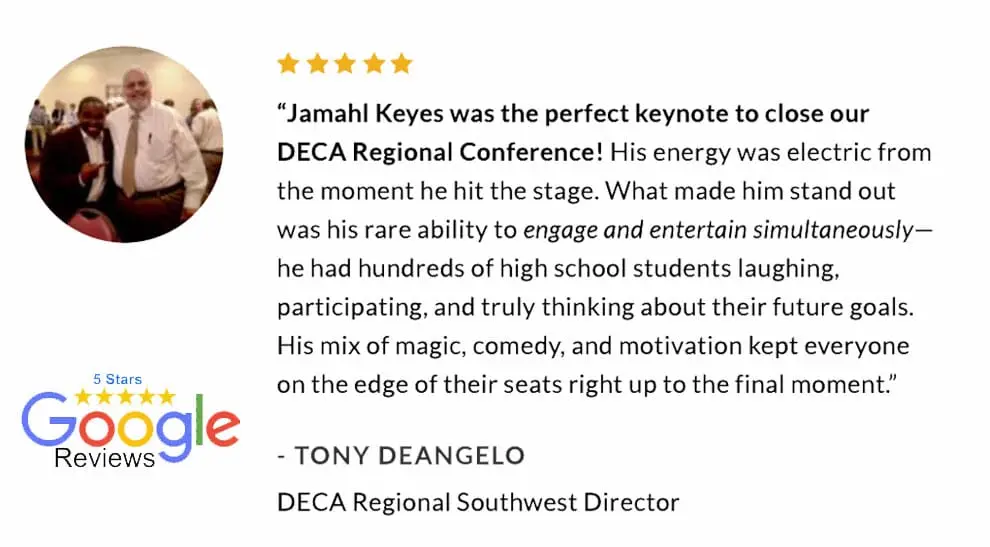
Charlie Adams Experience With Jamahl Keyes
Before:
Award Winning Author and Keynote Speaker Charlie was searching for a closing Keynote that would truly energize and unite the audience of over 800 High School Students at a Conference.
After:
“Jamahl Keyes took the stage and absolutely blew the audience away. His finale wasn’t just entertaining — it was transformational. Students left with tears of laughter and hearts full of inspiration. The perfect closing speaker.”
— Charlie Adams, Award-Winning Youth Speaker & Author
A good pre- or post-testing assembly is essentially a large-group SEL and culture intervention when you design it around:
- Self-management: How to handle nerves on test day
- Growth mindset: “This test measures what you’ve learned, not who you are.”
- Goal-setting: What success looks like beyond a single score
- Belonging: “We’re all in this together, and your effort matters to us.”
Program providers and school culture experts note that assemblies can boost engagement, critical thinking, and emotional resilience by giving students diverse learning experiences outside the regular classroom routine.Academic Entertainment+1
When you time that impact right—just before or after ILEARN—you’re aligning SEL with your highest-stakes academic moment.
3. Why a Pre-Testing Assembly Works: Prime the Brain Before the Big Game
Think of a pre-ILEARN assembly as a pep rally with a purpose.
Here’s what a well-designed pre-testing assembly can do:
1. Reset the Narrative Around ILEARN
Right now, students hear:
- “This is a big deal.”
- “It’s on the news.”
- “We need to get our scores up.”
But they don’t always hear:
- “You are more than a test score.”
- “We believe in you because of your effort, not your percentile.”
A motivational assembly can reframe ILEARN as:
- A snapshot of what they’ve learned
- A chance to show grit and growth
- One step toward future goals—not a final judgment
This kind of reframing reduces perceived threat and supports better performance.
2. Directly Tackle Test Anxiety
In one large analysis, many students reported feeling physical symptoms like stomachaches, headaches, and racing heart due to test anxiety—symptoms that interfere with focus.UCLA School Mental Health Project+1
A pre-test assembly can:
- Teach simple breathing and grounding techniques
- Let students practice them as a group
- Normalize the feeling: “If your heart races, it doesn’t mean you’re not smart—it means your body cares. Here’s what to do with that energy.”
When that message comes with humor, stories, and interactive activities, students actually remember and use the tools during ILEARN.
3. Build a Shared Culture of Effort
Assemblies are one of the few times you have the entire grade—or entire school—together. Used well, that moment can:
- Set expectations: “We are a school that gives our best effort on ILEARN.”
- Celebrate growth stories from your own students
- Publicly thank teachers and staff for preparing them
Research on school culture shows that supportive, inclusive environments are linked to reductions in absenteeism and better engagement.Aperture Education That engagement directly affects who even shows up on testing day—and how seriously they take it.
4. Why a Post-Testing Assembly Matters Just as Much
Many schools pour energy into ILEARN prep… and then do nothing intentional after testing except go back to “business as usual.”
That’s a missed opportunity.
Post-Testing Assemblies Help You:
- Close the Stress Cycle
Tests create a buildup of stress. Without a moment to release it, that tension turns into burnout and cynicism.
A post-testing assembly can:
- Celebrate effort, not just results
- Give students a fun, positive experience associated with “all that hard work”
- Allow them to reflect on what they learned about themselves in the process
- Protect Motivation for the Rest of the Year
If students experience ILEARN as nothing but pressure, they may disengage from learning once it’s over: “The test is done, so why try?”
A post-test assembly can:
- Reconnect learning to real-life goals
- Preview exciting projects or units that are coming next
- Reinforce the message: “The skills you built for ILEARN will help you in middle school, high school, and beyond.”
- Share Wins and Growth Stories
Even if proficiency is still below where you want it, growth is worth celebrating.
You can:
- Highlight classes or grades that improved
- Tell stories about students who worked hard, showed up, and didn’t give up
- Show a fun, interactive program that anchors those positive feelings to school itself
That kind of public recognition strengthens school pride—which feeds engagement going into next year’s ILEARN cycle.
5. “We Don’t Have Time for an Assembly” — The ROI Argument
A common objection from administrators:
“We can’t afford to pull students from instructional time right before testing.”
But consider the trade-off.
- You might invest 45–60 minutes in a carefully planned assembly.
- If that assembly reduces anxiety, increases focus, and boosts effort for every student in a grade level, the payoff shows up in:
- More students actually finishing the test
- Fewer “I just guessed” bubbles
- Better attendance on testing days
- Higher engagement in the weeks leading up to ILEARN
Given that Indiana’s ELA proficiency has barely moved in several years while math has improved only graduallyThe 74 Million+1, even a small bump in effort and focus can matter at the building level.
From a leadership perspective, an assembly is one of the most time-efficient ways to shift:
- Student mindset
- School culture
- Emotional readiness for testing
…all at once.
6. What an Effective ILEARN-Focused Assembly Should Include
Whether you bring in an interactive youth speaker, an educational magician, or a SEL-themed program, look for these elements:
- High Engagement:
- Audience participation
- Stories students can see themselves in
- Humor and surprises to hold attention
- Clear SEL Objectives:
- Coping strategies for nervousness
- Growth mindset language
- Belonging and school pride messages
- Direct Connection to ILEARN:
- Simple, non-technical test-taking tips
- Encouragement to read carefully, check work, and persevere through hard items
- A reminder that effort is the one thing fully in their control
- Action Steps They Can Use Tomorrow:
- A 3-step calming routine for test morning
- A short affirmation they can repeat to themselves
- A “test day checklist” they can visualize (sleep, breakfast, arrive on time, breathe, try your best)
Some schools around the world are already incorporating positive affirmations into their daily assemblies to reduce stress and boost emotional resilience—an approach backed by mental health experts.The Times of India Done intentionally, your ILEARN assembly becomes the high-impact version of that same idea.
7. Making It Concrete for Indianapolis Schools
If you’re a principal or instructional leader in an Indianapolis-area school, here’s how to put this into action:
Pre-Testing Assembly (2–3 weeks before ILEARN)
- Focus: Motivation, mindset, SEL coping tools
- Goal: Reduce anxiety, increase a sense of readiness and school pride
- Recommended length: 45–60 minutes
Post-Testing Assembly (within 1–2 weeks after)
- Focus: Celebration, reflection, future goals
- Goal: Protect motivation, reinforce that effort is valued, close the stress loop
- Recommended length: 45–60 minutes
You can:
- Partner with a local interactive youth speaker or educational magic show that specializes in school assemblies and SEL themes.
- Align the assembly message with your school improvement plan and ILEARN goals.
- Use the assembly as a launchpad for classroom follow-up (journals, discussions, goal-setting).
Final Thought:
If Indianapolis schools continue to treat ILEARN as a purely academic problem, we’ll keep getting the same mixed results:
- Slow gains
- Wide gaps
- High stress
But when we treat it as an academic + emotional + cultural challenge, a well-crafted school assembly—before and after testing—becomes more than a “feel-good” event.
It becomes a strategic lever for:
- Reducing test anxiety
- Strengthening school pride
- Delivering SEL at scale
- Giving students the mindset and resilience they need to show what they truly know on ILEARN.
Book Your High-Impact 2026 School Assembly Today!
Dates fill fast for Indianapolis & surrounding areas.
➡️ Schedule your assembly now:
Frequently Asked Questions (FAQ)
Q 1: What grade levels is this assembly best for?
Q 2: How long does the assembly run?
Q 3: Are the messages aligned with curriculum or social goals?
Q 4: How far in advance should we book?
Q 5: What is needed on the school side?